With a trade deal between China and the US and with Democrats taking back the House of Representatives, we expect a more measured approach and a trade deal with China before the end of the year. This is particularly important as global stock markets have grown more sensitive and volatile in recent months. With peak valuations in real estate and stock markets behind us, capital markets are looking for stability from the world's largest economies.
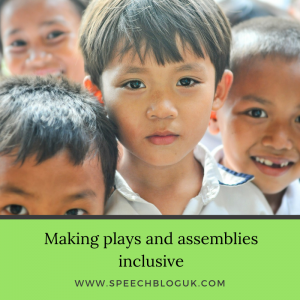
It may still be November, but some of the schools I visit are already starting to practise their Christmas plays. So I thought I would write about how to make plays and assemblies more accessible for children with speech and language difficulties. Every child should be included; you might juts have to think laterally about a few things!
Don’t assume
It can be easy to think that plays will just be too stressful for the child or that they can’t take part. However, with the right practise and support most children can take part in some shape or form. However, if it is really too stressful, talk to the child (if appropriate) or their family about what is best for them.
Costumes
For some children, getting them into and then getting them to stay in funny clothes maybe very hard. I will always remember one young man I worked with who was a sheep in the Christmas nativity play. He didn’t really like getting changed anyway and certainly not into a white fluffy sheep costume with a hood that covered his head. So we practised. We practised in class, we practised in the rehearsals and we even practised in speech therapy! We were practising body vocabulary so it tied in nicely. On the day, he got changed into the costume with minimal complaints, went on stage, performed his dance to his very proud parents and was then immediately allowed out of the hall and out of the sheep costume!!
Practise really helps. If that just isn’t going to work, think about other clothes they could wear; if they are a sheep, could they just wear a white t-shirt from home? Otherwise is there a part that doesn’t require a specific costume? Can they just take off their school jumper?
Noise
If the noise and singing and dancing and lights are just too much, can the child come in for their part and then be allowed to leave? They don’t have to sit squirming for the whole thing. If they can stay in, sit them near a known adult who can support/ sign/ use pictures to support the child to sit and follow the cues.
Where are you sitting?
Make sure they know where they will be sitting and where they have to move to. It might also help if they know where mum and dad are going to sit (if you can arrange this). Sometimes looking for loved ones can be too distracting. This also ties back in with my point about practising.
Preparation
Try and explain that on the day there will be lots of people in the audience. Try showing them pictures – you don’t want it to be a surprise on the day. Put yourself in their position. You know them well. Which things are likely to be tricky for the child? Try and predict and make appropriate changes.
Lines
If the child has lines to say, make sure they have enough time to practise and almost over learn them. Can they have the words or a prompt card on stage? If not make sure there is an adult to prompt if they forget. When practising you could put symbols with the words to help them remember. Think carefully about the words: does it need all the tricky words or could you make the sentences simpler and not change the meaning? If you have a child with speech difficulties, make sure you aren’t asking them anything they really can’t say. Again, can you change a word to make it more achievable for them?
I truly believe all children have the ability to amaze with the correct support. So before you rule them out of a part or the play all together, think about what you can change to make it achievable for them. I didn’t think that young man would remain in his sheep costume, remember the song and dance and join in with everyone – but he did. Happy nativities everyone!
Electronic Commerce: Otherwise known as ‘E-commerce’- a term for any type of business or commercial transaction that involves the transfer of information across the Internet. The world of E-commerce is almost as dense and complex as the effect that it … Continue reading →
This week will touch on some of the highlights from the Mortgage Professionals Conference in Montreal. This is the largest conference in our industry and features all of the significant players in the broker industry.
Hearing your child talk for the first time is a very special milestone moment for most parents – especially the moment they first say “mummy” or “daddy”! For most children this seems to happen effortlessly. This isn’t always the case though. Some children take a bit longer to pick up language skills. Whether your child is an early talker or a later talker, these 10 tips will help you to support their language skills at home.
One important thing before I start on this list though! For some children, following these tips will not be enough. If you are concerned that your toddler is not developing early language, do get them referred to a speech and language therapist. However, the wait can be long. While you are waiting – here are some things to try.
10 tips to encourage early language
Get down on the floor and play. This may sound very obvious, but we are all so busy – how often do you actually put everything else aside and just play with your child? Try and find a few minutes every day when you can do this.
Follow your child’s lead. This can be hard as an adult. Join your child in playing with what they have chosen. Often it can be hard to see the appeal and you may have an idea that seems more exciting, but they are going to engage much better with something they have chosen.
Comment on what they are doing. As adults, we tend to ask a lot of questions of children, especially if we are trying to encourage them to talk to us. Try commenting on what they are doing instead. Keep your comments short. If your child is not really talking yet, or only using single words, keep your comments to 1-3 words. E.g. “car… brrm brrm…. Car driving…. Oh no!… crash!”
Add to what they say. If your child says something, great! Repeat it back for them to hear and add a word or two. E.g. if your child says “teddy”, you might say “yes, teddy sleeping”
Use symbolic noises. By this I mean car noises, animal noises etc. These are often easier for children to say than words to begin with. Make lots of sounds as your child is playing. E.g. if you are play cooking, make the pan go “ssss” or the cooker go “ding”.
Sing. Songs can be a great way of learning early words. Don’t worry about what your voice sounds like, your child doesn’t care! Do action rhymes and nursery rhymes together. Once they know a rhyme well, stop at an important point and see if your child will carry on and fill in the word. We have more about this here.
Focus on communication not speech. There is so much to communication, not just speech. The more your child is able to communicate successfully, the more they will want to try. Interpret their body language and use signs and gestures along with your words.
Look at books together. To start with, your child may not have the attention span to listen to you read a story. That’s fine – just look through the book together. Try sound books and lift-the-flap ones to start with so that child is active and involved. We have more about how to use books here.
Talk about what you are doing together. You don’t need particular toys or activities to work on language skills. Just chat about what you are doing. Routine activities like bedtime and mealtimes are great as they happen frequently so your child is hearing the same words over and over again.
Don’t be afraid of silence. Leave lots of pauses in case your child wants to talk. If you have a child that doesn’t talk, it can feel like you are having a one-sided conversation and you stop expecting a reply. Keep pausing and looking to them for their response even if you don’t get one. You are teaching them conversation skills.
As expected, the Bank of Canada increased its overnight rate on Wednesday to 1.75%. Canadian banks are responding by announcing increases to their Prime Lending Rate. The Bank Prime is now at 3.95%. For those in a Variable or Adjustable Rate Mortgage, your lender will be notifying you of when their increase will take effect.
Do you have investment properties in California? I am going to tell you why it may be better to bring that investment money and invest it in Arizona. Hey everyone, I’m Dean Ouellette with the Phoenix Real Estate Guy. Today we are going to be talking investing and 1031 exchanges.
If you have an investment property and sell it, you are going to have capital gains taxes, and those are going to hit you pretty hard when you go to sell, especially if you bought in California in 1978 and that $70,000 property is now worth $700,000.
One thing you can do is you can sell those properties and reinvest that money in real estate in Arizona. Let’s say you have two properties in California, one is a single family and one is a duplex, between the two of them they are worth one and a half million dollars. That’s also one and a half million dollars invested in just two assets.
What we can do is bring that money back into Arizona using a 1031 exchange and spread that risk out a little bit. Now instead of two properties and three doors which are bringing you income you can bring that money to Arizona and maybe buy three condos near ASU and five single-family houses. The money you have invested is the same, but you spread out that risk.
If you have one door in California which goes vacant for two months you are losing one-third of your income, whereas if you have one door that goes vacant for two months in Arizona you spread that risk out and you are not losing as much monthly income.
There are a lot of nuances with the 1031 exchange and we can do a video discussing that, and I can talk to you in detail in person about what you can and can’t do, and how we can make it really work for you. But, if you are an investor who has money in another state and would like to bring it to Arizona, the good news is there are ways to do it and avoid the taxes.
If you’ve got any questions on this you can email medean@phoenixrealestateguy.comand again we’ll do another video on 1031 exchanges and go into more details on that in the upcoming weeks, but for now, if you have any thoughts or questions on this leave a comment or shoot me an email.
Originally posted on Phoenix Real Estate Guy. If you are reading this anywhere but inside your RSS feed reader or your email client, the site you are on is guilty of stealing content.
(c) Copyright Jay Thompson. All Rights Reserved.
from The Phoenix Real Estate Guy https://ift.tt/2DejVXW